Introduction
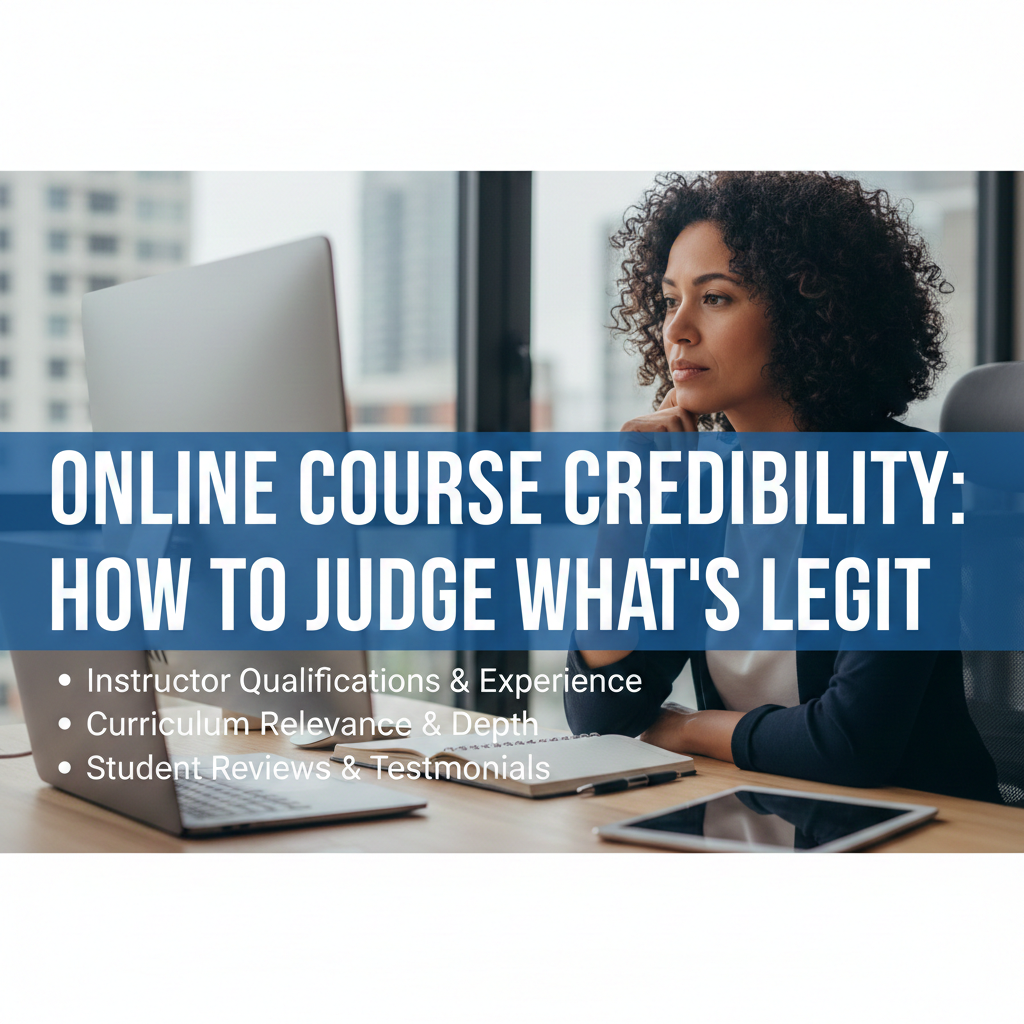
Online course credibility depends on skill depth, practical outcomes, and alignment with real job tasks—not platform popularity, influencer promotion, or certificate design.
As online learning expands, credibility has become harder to judge. Anyone can launch a course, issue certificates, and promise transformation. From real hiring and learning outcomes, most employers don’t ask where you studied—they ask what you can do. This article explains how to evaluate online course credibility realistically, identify trustworthy signals, avoid common traps, and choose learning that holds value beyond marketing claims.
Why Online Course Credibility Is So Confusing
The confusion comes from mixed signals.
Learners are exposed to:
Aggressive marketing language
Social proof without context
Certificates presented as credentials
Meanwhile, employers evaluate learning very differently. They don’t see course pages—they see outcomes.
[Expert Warning]
A course that sells transformation but can’t explain learning outcomes is a credibility risk.
What Makes an Online Course Credible
From real evaluation patterns, credible courses share these characteristics:
- Clear Skill Outcomes
The course states exactly what you’ll be able to do—not vague growth claims.
- Practical Application
Assignments, projects, or case work mirror real tasks.
- Instructor Transparency
Clear background, experience, and teaching focus.
- Realistic Scope
No exaggerated promises about jobs or income.
Courses lacking these elements rely heavily on marketing to compensate.
What Does NOT Indicate Credibility
Many learners misjudge credibility by focusing on:
Platform size
Certificate design
Celebrity instructors
Large enrollment numbers
These factors may indicate popularity—but not learning quality.
[Pro-Tip]
Credible courses explain limitations as clearly as benefits.
Common Mistakes Learners Make
Mistake 1: Trusting Marketing Over Content
Fix: Review syllabus depth and assignments.
Mistake 2: Confusing Certificates With Credibility
Fix: Look for skill demonstration, not completion proof.
Mistake 3: Ignoring Employer Language
Fix: Match course outcomes with job descriptions.
Information Gain: The “Explain-It” Test
Most SERP articles suggest checking reviews or instructor bios.
What they miss is the most powerful credibility test:
Can you explain what you learned in job language?
If you can’t translate course learning into:
Tasks
Decisions
Trade-offs
Then the course lacks applied credibility.
Contrarian insight:
Courses that feel “harder” or slower often build more credibility than fast, polished programs. This nuance is rarely discussed in top-ranking content.
Practical Insight From Experience
From real learning journeys, credible courses often feel uncomfortable. They force you to think, practice, fail, and revise. Less credible courses feel smooth and motivating—but leave little behind. Difficulty is not a flaw; it’s often a signal of depth.
Practical Table: Online Course Credibility Checklist
| Credibility Factor | Strong Signal | Weak Signal |
| Skill outcomes | Specific | Vague |
| Assignments | Applied | Quizzes only |
| Instructor background | Relevant | Unclear |
| Job alignment | Obvious | Missing |
| Claims | Realistic | Exaggerated |
How Credibility Affects Certificates and Resumes
Certificates from credible courses:
Support skill claim
Reinforce learning continuity
Reduce employer uncertainty
Certificates from weak courses:
Add noise
Raise skepticism
Dilute stronger signals
To understand certificate impact fully:
Internal Link (contextual): course certificate value → Online Courses With Certificates
FAQs
How do I know if an online course is credible?
Check skill outcomes, assignments, and job alignment.
Are popular courses more credible?
Not necessarily—popularity doesn’t equal depth.
Do employers care where you learned?
They care about what you can do, not platforms.
Are certificates a sign of credibility?
Only when paired with real skills.
Should beginners avoid difficult courses?
No—difficulty often signals depth.
Conclusion
Online course credibility isn’t about names or numbers—it’s about evidence. From real outcomes, credible courses teach skills you can explain, apply, and defend. When you evaluate learning through outcomes instead of hype, you stop chasing certificates and start building capability. Choose courses that challenge you, respect your time, and prepare you for real work—not just completion.
Internal link:
Best Online Course for Job Skills: How to Choose Right 2026
External link: