Introduction
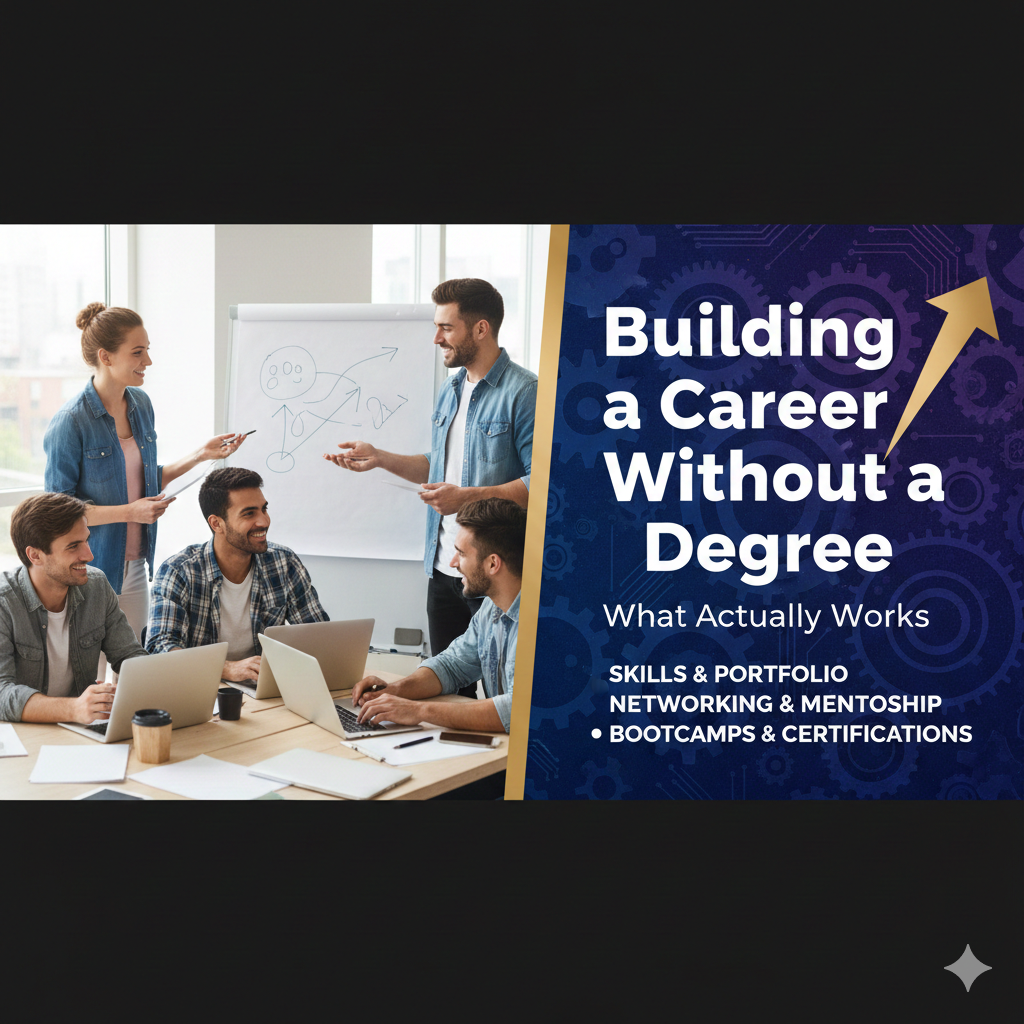
A career without a degree is possible when you build job-relevant skills, demonstrate reliability, and reduce hiring risk for employers—rather than relying on credentials alone.
As education costs rise and career paths become less predictable, more people are questioning whether a degree is the only route to stability. Online advice often swings between extremes: “degrees don’t matter at all” or “you can’t succeed without one.” From real hiring and career outcomes, the truth sits in the middle. This article explains how careers without degrees are actually built, what employers prioritize, where people succeed or fail, and how to approach a degree-free path with realism instead of hype.
Why Degrees Are Still Used as Filters
Degrees were designed as screening tools, not proof of ability.
Employers historically used degrees to:
Filter large applicant pools
Signal baseline education
Reduce uncertainty
However, as roles evolve and skills change faster, degrees alone no longer predict performance. Many employers now focus on what you can do, especially in skill-based roles.
[Expert Warning]
Degrees are often filters, not guarantees. Understanding this distinction changes how you plan a degree-free career.
What Employers Actually Look for Without a Degree
From real hiring behavior, employers hiring candidates without degrees focus on:
- Skill Evidence
Projects, portfolios, work samples, or task demonstrations.
- Reliability Signals
Consistency, communication, and follow-through.
- Role Understanding
Knowing what the job involves—not just wanting the title.
- Learning Ability
The capacity to pick up new tools and processes quickly.
These signals often outweigh formal education in practice.
Common Career Paths That Don’t Require a Degree
Rather than listing job titles, focus on role categories:
| Career Category | Why Degrees Are Optional |
| Operations & coordination | Process-driven work |
| Sales & customer success | Performance-based outcomes |
| Skilled trades | Practical competency |
| Digital marketing & content | Skill demonstration |
| Administrative & support roles | Task reliability |
| Compliance & safety roles | Certification-based hiring |
These roles prioritize performance over paperwork.
Common Mistakes People Make
Mistake 1: Ignoring Skill Proof
Fix: Build tangible examples of your work.
Mistake 2: Applying Without Understanding the Role
Fix: Study job descriptions and daily responsibilities.
Mistake 3: Assuming Degrees Don’t Matter Anywhere
Fix: Target degree-flexible industries and roles.
[Pro-Tip]
Candidates without degrees who can clearly explain how they solve problems often outperform degree-holders who cannot.
Information Gain: The Proof Hierarchy Employers Use (SERP Gap)
Most SERP articles say “skills matter more than degrees.”
They don’t explain how employers judge proof.
Here’s the real hierarchy used in hiring:
| Proof Type | Employer Weight |
| Demonstrated work results | Very High |
| Relevant experience | High |
| Portfolio / projects | High |
| Certifications | Medium |
| Degree | Medium |
| Self-claims | Low |
Contrarian insight:
A strong portfolio can outperform a weak degree—but a weak portfolio rarely outperforms anything. This clarity is missing from most ranking content.
Practical Insight From Experience
From real workplace patterns, many non-degree professionals advance faster once hired because they focus intensely on performance and learning. Without degrees to “lean on,” they build credibility through delivery. Over time, this creates strong internal trust—often leading to promotions that ignore formal education entirely.
Performance becomes the credential.
How Certifications Help in a Degree-Free Career
Certifications can:
Reduce employer uncertainty
Signal structured learning
Fill knowledge gaps
They work best when aligned with roles.
Internal Link (contextual): certification-based careers → Career Path With Certification
| Factor | Positive Sign | Risk |
| Skill evidence | Strong | None |
| Industry choice | Degree-flexible | Degree-heavy |
| Learning discipline | Consistent | Sporadic |
| Role clarity | High | Vague |
FAQs
Can I build a career without a degree?
Yes, especially in skill-based and performance-driven roles.
Do employers still require degrees?
Some do, but many focus on skills and experience.
Are certifications necessary without a degree?
They help—but only when paired with practice.
Which careers don’t require degrees?
Operations, sales, trades, marketing, and support roles.
Will I hit a career ceiling without a degree?
Sometimes—but strong performance often breaks ceilings.
Conclusion
A career without a degree is not a shortcut—it’s a different strategy. From real-world outcomes, people succeed when they replace credentials with proof, curiosity, and consistency. Choose roles where skills matter, build evidence relentlessly, and communicate your value clearly. When you do that, degrees become optional—and performance becomes everything.
Internal link:
How to Choose a Career Path (Practical, Real-World Guide) 2026
External link: