Introduction
A career path with certification works only when certifications support real skill development, align with job roles, and are used as progression tools—not shortcuts or substitutes for experience.
As certifications become more accessible, many people plan entire careers around them without understanding how employers actually interpret credentials. From real hiring and career progression patterns, certifications can accelerate growth—but only when used strategically. This article explains how certification-based career paths function in reality, when they create opportunities, where they fail, and how to design a path that builds credibility instead of confusion.
Why Certifications Attract Career Planners
Certifications promise clarity in a messy job market.
People are drawn to them because they:
Offer defined learning paths
Feel measurable and concrete
Appear faster than degrees
In practice, certifications are most effective as career signals, not career foundations.
[Expert Warning]
Planning a career entirely around certifications without real-world application leads to stalled growth.
How a Certification-Based Career Path Actually Forms
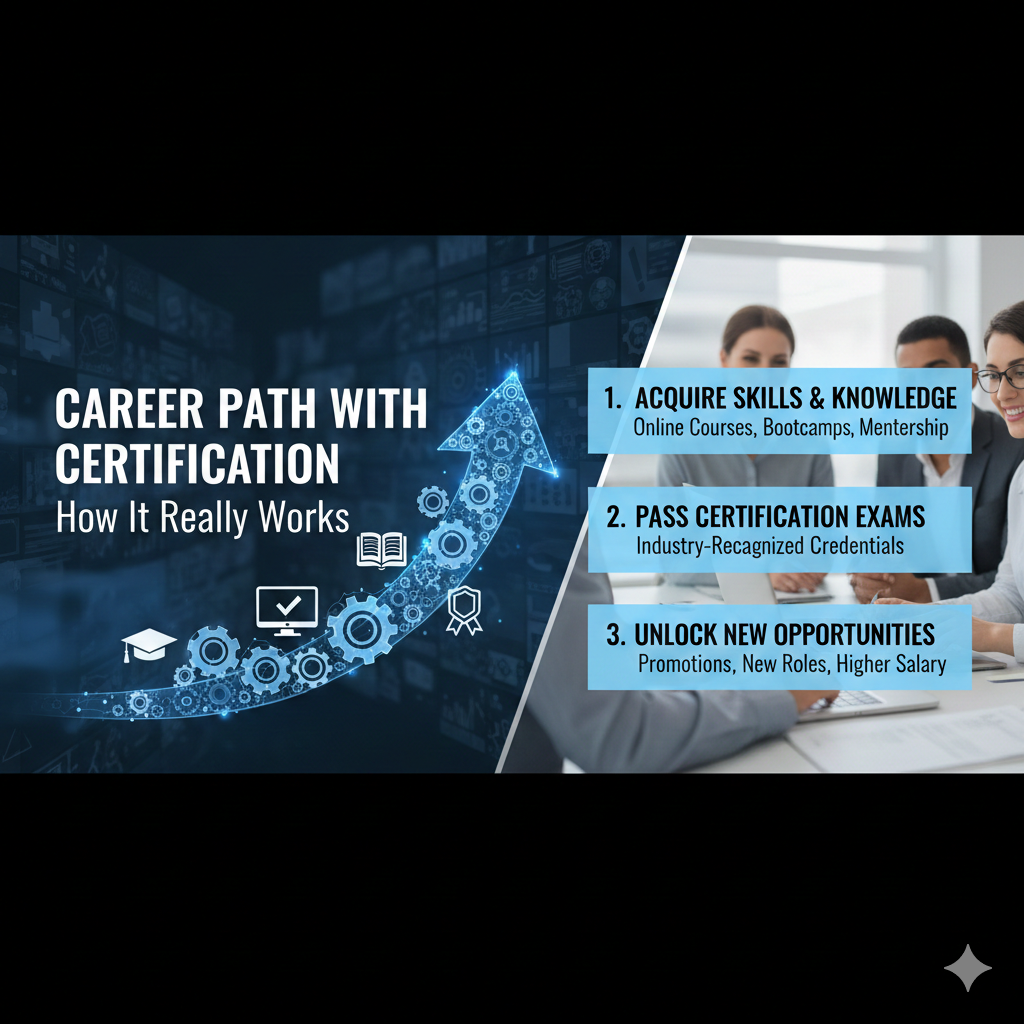
From real career trajectories, certification-based paths usually follow this order:
Foundational certification (context + basics)
Entry-level role or practical exposure
Role-aligned certification
Experience-driven advancement
Skipping steps weakens outcomes.
The Key Difference
Certifications open doors—but experience keeps them open.
When Certifications Truly Accelerate Careers
Certifications work best when:
- Roles Have Clear Skill Standards
Fields like IT support, compliance, or operations benefit most.
- Certifications Reduce Training Time
Employers trust standardized learning.
- Skills Can Be Demonstrated Quickly
Hands-on labs or applied tasks increase credibility.
[Pro-Tip]
The best certification paths mirror how jobs are structured—not how courses are marketed.
Common Mistakes People Make
Mistake 1: Stacking Certifications Without Experience
Fix: Apply each certification before pursuing the next.
Mistake 2: Choosing Certifications Without Role Context
Fix: Read job descriptions before enrolling.
Mistake 3: Expecting Linear Progression
Fix: Expect plateaus—certifications don’t replace performance.
Information Gain: Why Certification-Only Careers Stall
Most SERP articles imply more certifications equal more opportunity.
What’s missing:
Employers cap the value of credentials quickly
Performance overtakes certification signals
Over-certified candidates raise skepticism
Contrarian insight:
After a certain point, another certification adds less value than deeper experience. This diminishing return is rarely discussed in top-ranking content.
Real-World Scenario
Two professionals follow certification-heavy paths.
One earns multiple certifications but avoids real projects
The other earns fewer certifications but applies each one
After three years:
The first struggles to advance
The second moves into responsibility
From real outcomes, application beats accumulation every time.
Practical Table: Designing a Career Path With Certification
| Career Stage | Certification Role | Focus |
| Beginner | Foundational | Context & basics |
| Entry-level | Role-aligned | Skill validation |
| Mid-level | Advanced | Depth & leadership |
| Senior | Optional | Specialization |
This structure keeps certifications supportive—not dominant.
Where Certifications Fit With Other Learning
Certifications work best when combined with:
On-the-job learning
Mentorship
Self-directed projects
They work poorly when isolated from practice.
To ensure employer recognition, context matters.
Internal Link (contextual): recognized certifications → Certifications Employers Recognize
YouTube Video Suggestions (Contextual Embeds)
Embed naturally:
“How certifications impact career growth”
“Hiring manager explains certification value”
Videos should clarify expectations—not sell success.
FAQs
Can I build a career using only certifications?
Rarely. Experience and performance are essential.
When do certifications help most?
Early and mid-career when aligned with roles.
Do employers prefer certified candidates?
Only when certifications reduce training risk.
How many certifications are too many?
When they outnumber real work examples.
Should beginners focus on certifications?
Yes—but only foundational ones with practice.
Conclusion
A career path with certification works when credentials support real work—not when they replace it. From real-world patterns, professionals who treat certifications as tools for progression rather than guarantees advance faster and with less frustration. Choose certifications that align with roles, apply what you learn immediately, and let experience—not badges—drive your career forward.
Internal link:
Career Change at 30: What Really Changes & What Doesn’t
External link: