Introduction
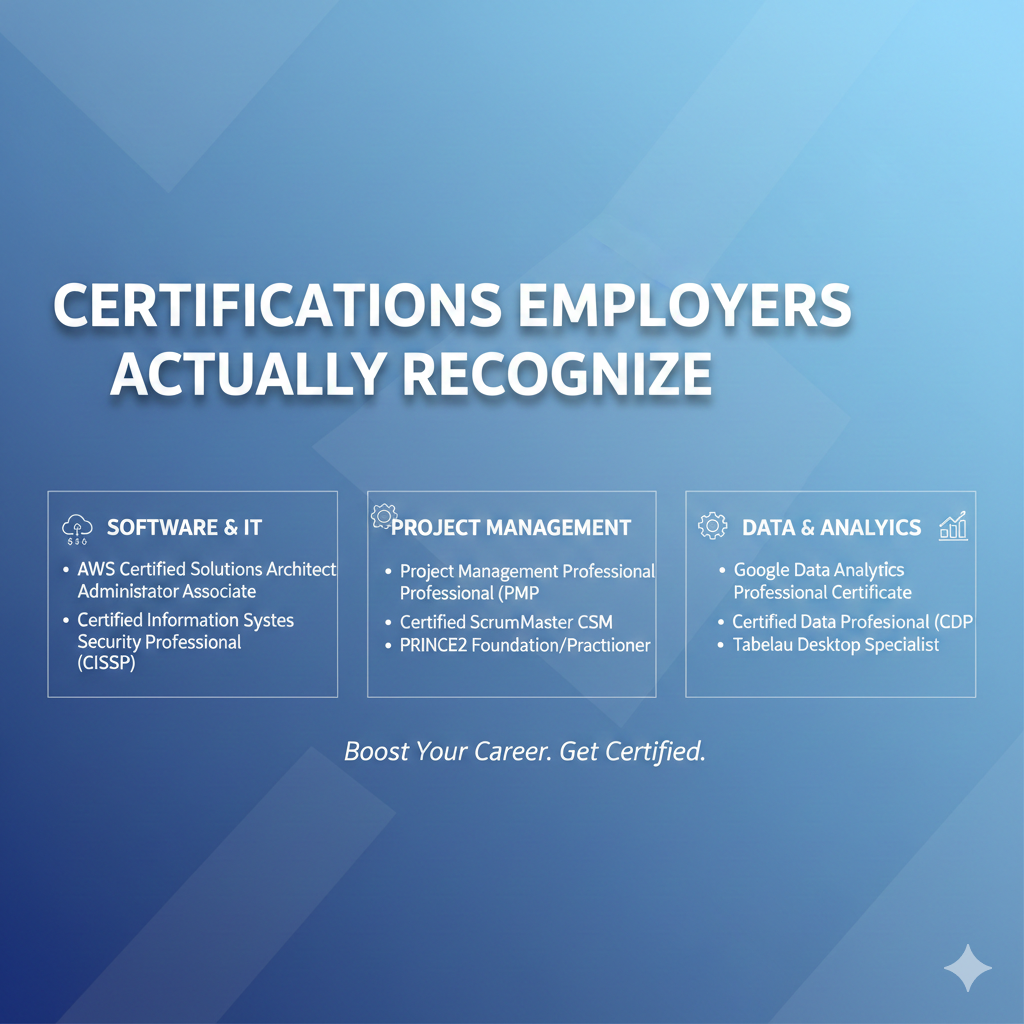
Certifications employers recognize that clearly signal job-relevant skills, align with real workplace tasks, and reduce hiring risk—not those that are simply popular or heavily marketed.
As certifications become easier to obtain, employers have become more selective about which ones they trust. From real hiring behavior, most employers don’t reject candidates for lacking certifications—but they do ignore certifications that don’t translate into practical value. This article explains how employer recognition really works, what signals hiring managers trust, and how you can choose certifications that support real career outcomes instead of adding noise to your resume.
How Employer Recognition Actually Works
Employer recognition isn’t about logos or platforms—it’s about predictability.
Hiring managers ask:
Can this person perform job tasks?
Does this certification reduce training risk?
Is the skill standardized or widely understood?
Certifications are recognized when they help answer these questions clearly.
[Expert Warning]
A certification no one can map to real job tasks is rarely recognized, no matter how impressive it sounds.
What Employers Look for in Recognized Certifications
From practical hiring patterns, recognized certifications usually share these traits:
- Clear Skill Scope
The certification defines what you can do, not just what you studied.
- Industry Standardization
Certifications tied to common tools, processes, or compliance are easier to trust.
- Practical Verification
Employers prefer certifications that require applied tasks, labs, or scenarios.
- Role Alignment
The certification matches a specific job function, not vague “career growth.”
Types of Certifications Employers Commonly Recognize
Rather than brand names, employers respond to categories:
| Certification Type | Why Employers Trust Them |
| Role-based certifications | Clear job responsibilities |
| Compliance & safety certifications | Hiring requirement |
| Standardized technical certifications | Predictable skill level |
| Process-driven operations certs | Reduced onboarding risk |
Common Mistakes People Make
Mistake 1: Assuming Recognition Equals Popularity
Fix: Check whether the certification appears in job descriptions.
Mistake 2: Choosing Certifications With Vague Outcomes
Fix: Look for certifications that describe exact skills or tasks.
Mistake 3: Listing Certifications Without Context
Fix: Explain how the certification relates to your role or projects.
[Pro-Tip]
If you can’t explain how a certification helps you perform better at work, employers won’t value it either.
Information Gain: Why Employers Ignore Most Certifications (SERP Gap)
Most SERP articles say, “Employers value skills over certificates.”
What they don’t explain is why certifications are ignored.
Here’s what’s missing:
Certifications don’t reduce hiring risk by default
Employers can’t assess depth from completion alone
Many certifications lack consistent standards
Contrarian insight:
Employers don’t distrust certifications—they distrust unclear signals. Certifications that clarify expectations are recognized; others are ignored.
This nuance is rarely explained on page one.
Practical Insight From Experience
From real hiring discussions, certifications often help after an interview starts—not before. They provide supporting evidence once an employer already sees potential. Candidates who use certifications to explain how they think and work gain more credibility than those who simply list them.
Recognition is about reinforcement, not replacement.
How to Check If Employers Recognize a Certification
Before enrolling, do this:
Search job listings for the certification name
Check if it’s listed as “required” or “preferred”
Read role descriptions for matching skills
See if multiple companies reference it
If employers aren’t mentioning it, recognition is likely low.
[Money-Saving Recommendation]
Never enroll in a certification without first checking real job postings.
Where Recognized Certifications Fit in Career Planning
Recognized certifications work best as:
Skill validators
Hiring conversation enhancers
Onboarding risk reducers
They work poorly as:
Standalone credentials
Career guarantees
Experience substitutes
If you’re building skills strategically, context matters.
Internal Link (contextual): skills employers need → Skills in Demand
| Question | Yes | No |
| Mentioned in job ads | Strong signal | Weak |
| Linked to job tasks | Valuable | Vague |
| Requires applied work | Trusted | Ignored |
| Standardized skill set | Reliable | Inconsistent |
FAQs
Which certifications do employers recognize most?
Those that align with job tasks and industry standards.
Do employers care about certification platforms?
Less than they care about skill clarity and application.
Are expensive certifications more recognized?
Not necessarily—value depends on relevance.
Should beginners focus on recognized certifications?
Only after building foundational skills.
Do certifications guarantee jobs?
No—they support hiring decisions, not replace them.
Conclusion
Certifications employers recognize are not mysterious—they are predictable. They clarify what you can do, reduce uncertainty, and align with real work. From real hiring outcomes, the smartest candidates choose certifications strategically, not emotionally. When you understand how recognition works, certifications stop being guesses and start becoming tools.
Internal link:
Best Certification for Beginners Without Experience – InstituteVia
External link: