
Introduction
(Featured Snippet Priority)
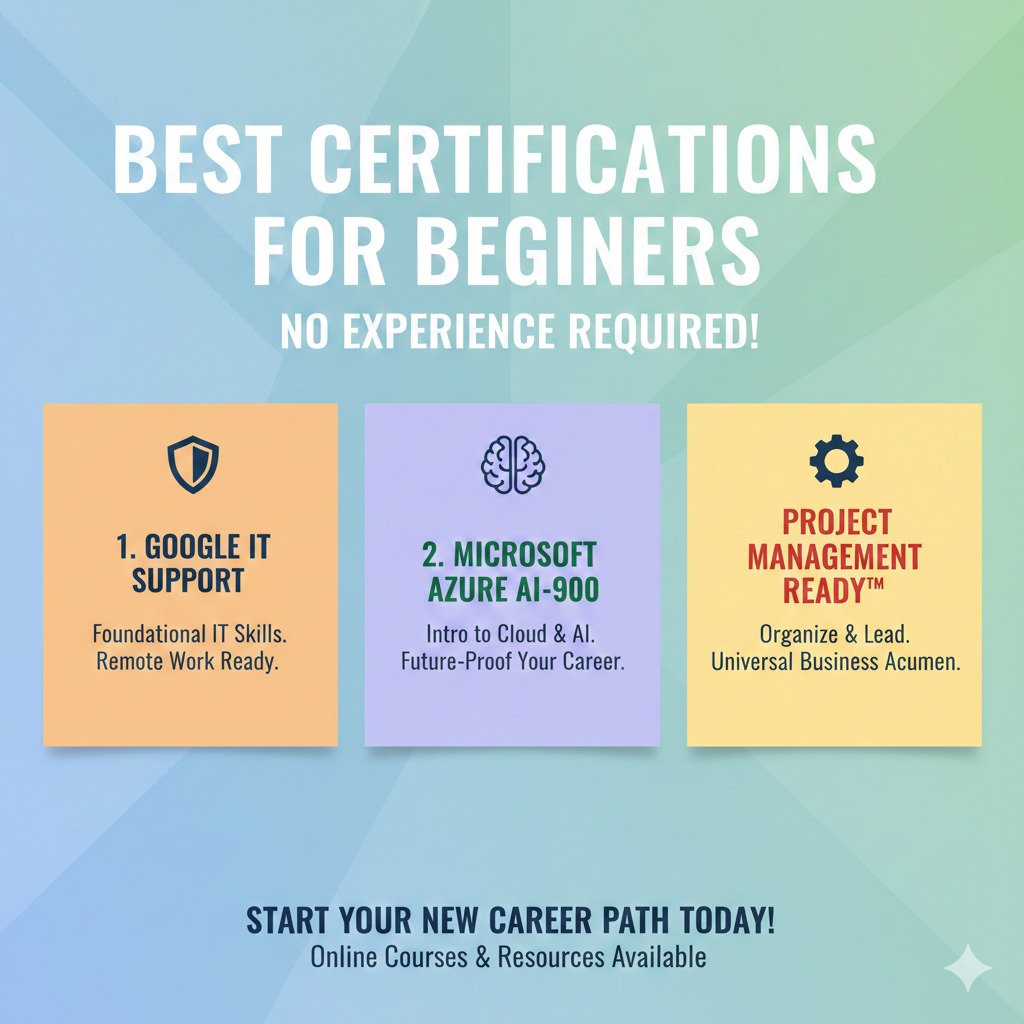
The best certification for beginners without experience is one that teaches core concepts from scratch, includes guided practice, and does not assume prior industry exposure.
Many beginners believe lack of experience disqualifies them from certifications. In reality, the opposite is true. Certifications are often most valuable before experience—when they provide structure, vocabulary, and confidence. The real risk is choosing certifications that pretend to be beginner-friendly but quietly expect prior knowledge.
This guide explains how beginners with zero background should choose certifications that actually teach, not intimidate.
What “No Experience” Actually Means
Having no experience does not mean lacking ability. It usually means:
You haven’t worked in the field professionally
You don’t know how roles connect
You’re unfamiliar with industry language
A true beginner certification should bridge the gap between curiosity and competence. Certifications that jump straight into tools, dashboards, or exams often confuse beginners instead of helping them.
Reality Check
If a certification syllabus starts with tools instead of concepts, it’s not designed for zero-experience learners.
Why Most Certifications Are Not Built for Beginners
Most certifications are designed for career switchers, not true beginners. This creates a hidden mismatch.
Common problems beginners face:
Lessons move too fast
Concepts are explained using insider language
Assessments test memory, not understanding
As a result, beginners blame themselves—when the certification was never meant for them.
Beginner-Safe Certification Characteristics
Before enrolling, beginners without experience should look for certifications that include:
- Concept-First Teaching
The certification explains why before how.
You understand the logic behind tasks, not just steps.
- Guided Practice
Hands-on work is explained step-by-step.
You’re not told to “figure it out.”
- Role Awareness
The certification explains how skills fit into real jobs.
- No Hidden Prerequisites
Nothing assumes prior knowledge—even basics are explained.
The Zero-Experience Evaluation Checklist
Use this checklist before enrolling:
| Question | Beginner Requirement |
| Does it explain fundamentals clearly? | Must-have |
| Are examples beginner-oriented? | Must-have |
| Are assignments guided? | Must-have |
| Does it explain career context? | Important |
| Is difficulty progressive? | Important |
If two or more answers are “no,” the certification is not beginner-safe.
Popular Beginner Certifications That Often Fail
Many widely recommended certifications fail beginners because they:
Focus on passing exams instead of learning
Teach tools without context
Assume familiarity with industry workflows
This does not make them bad certifications—it makes them bad first certifications.
Counter Insight
A certification can be respected and still be wrong for beginners.
What Employers Expect From Beginners With Certifications
Employers do not expect expertise from beginners.
They look for:
Conceptual understanding
Ability to explain what you learned
Willingness to apply and improve
A beginner who understands why things work is more valuable than one who memorized steps.
Free vs Paid Certifications for Beginners
Free Certifications
Good for exploration
Low pressure
Often lack depth
Paid Certifications
Better structure
Stronger accountability
Higher quality instruction
Best approach:
Start with one free intro, then move to one paid foundational certification.
Beginner Path Example (No Experience)
Month 1:
Learn fundamentals and terminology
Understand how the field works
Month 2:
Complete guided projects
Apply concepts weekly
Month 3:
Refine skills
Explore specialization options
This path builds clarity first, confidence second.
Comparison Table: Beginner Certification Levels
| Level | Suitable for Beginners? | Reason |
| Introductory | Yes | Builds foundation |
| Foundational | Yes | Teaches concepts |
| Intermediate | Sometimes | Depends on background |
| Advanced | No | Assumes experience |
FAQs
Can beginners with no experience take certifications?
Yes. The right certifications are designed to teach from zero.
Do certifications replace experience?
No, but they prepare beginners to gain experience faster.
Should beginners start with free certifications?
Yes, for exploration—but not as a final step.
Are exams important for beginners?
Understanding matters more than exam scores early on.
How many certifications should beginners take?
One foundational certification is enough to start.
Conclusion
The best certification for beginners without experience is one that teaches clearly, builds confidence, and allows growth. Beginners succeed when certifications are treated as learning frameworks, not proof of expertise.
Internal link:
Certification vs Degree: What Matters More in Careers? 2026
External link:


